A1 GrammarA1 Elementary
Can, can’t: Ability, possibility, permission
Can, can’t: Grammar chart
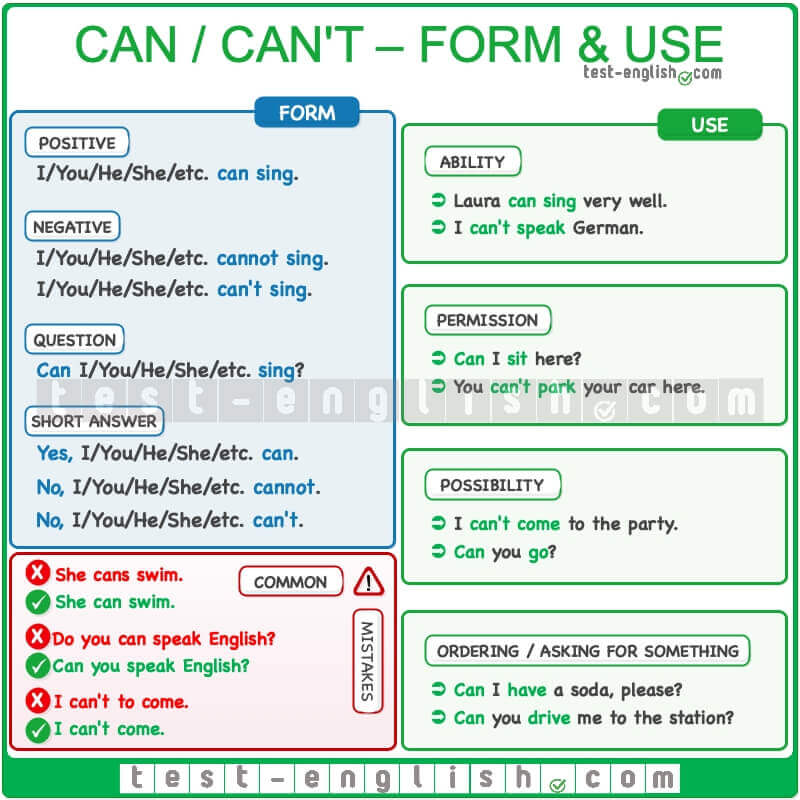
Download full-size image from Pinterest
Can, can’t: Form
Infinitive without to
We use can + infinitive without to.
- I can swim.

- I can to swim.

- We can’t come.
- We can’t to come.
Don’t use -s after he/she/it
We don’t add -s after he/she/it. We use can for all persons.
- He can swim.
- He cans swim.
Don’t use do/don’t
Can is an auxiliary verb and has a negative and interrogative form. We don’t use do/don’t to make questions and negatives.
- Can you swim?
- Do you can swim?
- He can’t swim.
- He don’t can swim.
Can, can’t: Use
Ability
We use can/can’t to talk about ability in the present (=things that we know how to do).
- Laura can sing very well.
- I can’t speak German.
Possibility
We use can/can’t to ask for permission or to say if something is possible or not.
- Can I sit here?
- You can’t vote if you aren’t 18 years old.
- I’m sorry, but I can’t come to the party.
Ask for something
We use can/can’t to ask for something and to order in bars, restaurants, shops, etc.
- Can you lend me some money?
- Can I have some water, please?
- Can I have a burger and a soda?
Ready to practice?
Put your knowledge to the test with interactive exercises (3 exercises available).
Download Lesson & Exercises as PDF
Get printable PDF worksheets for Can, can’t: Ability, possibility, permission including grammar explanations, exercises, and answer keys.
High-resolution grammar charts
Printable student worksheet
Complete answer keys & notes
Offline classroom ready