Verbs + to + infinitive and verbs + -ing
Verbs + -ing
Some verbs in English are followed by another verb in the -ing form. The most common of these verbs are verbs of liking and disliking: love, like, enjoy, don’t mind, don’t like, hate. If we use another verb after these verbs, it often takes the -ing form.
- I love going to the gym.
- I like reading.
- I enjoy travelling.
- I don’t mind cooking.
- I don’t like doing homework.
- I hate getting up early.
The second verb is in the -ing form in the past, too.
- When I was a child, I hated going to school.

- When I was a child, I hated went to school.

-ing spelling
You can check the spelling of the -ing form of the verbs in the table below.
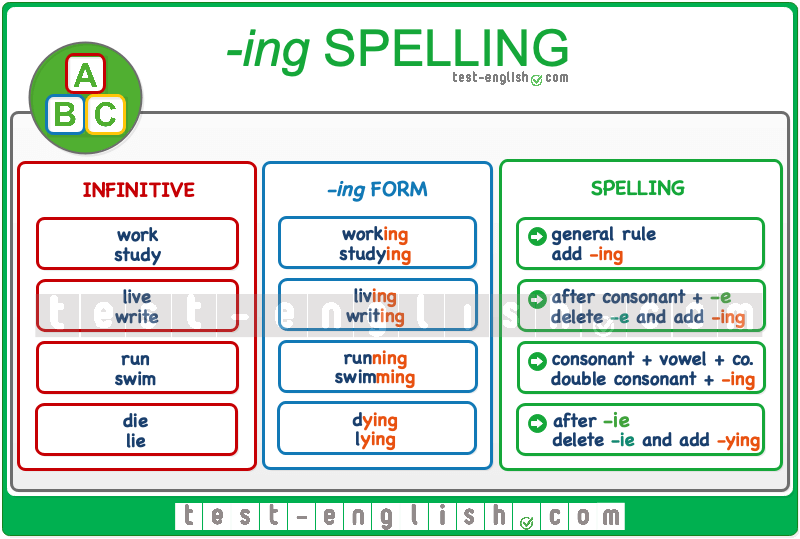
Download full-size image from Pinterest
Verbs + to-infinitive
Many verbs in English are followed by to-infinitive. Some of these verbs are forget, hope, learn, need, offer, plan, remember, start, want and would like.
- I forgot to turn off the light.
- I hope to see you soon.
- I‘m learning to drive.
- We need to arrive early.
- She offered to help us.
- We are planning to go to France.
- Remember to lock the door.
- I want to go home.
- I would like to buy a new computer.
The second verb takes the to-infinitive form in the past too.
- I wanted to go home.
- I wanted to went home.
Would like
The verb would like (or ‘d like) is different from like. We use would like + to + infinitive, and we normally use like + -ing verb to talk about general preference.
- I‘d like to study English.
- I like studying English.
The meaning is also different.
- I‘d like to study English. (=I want to do it.)
- I like studying English. (=I enjoy it.)
We use the question would you like… when we offer or suggest something.
- Would you like a cup of coffee?
- Would you like to dance with me?
Ready to practice?
Put your knowledge to the test with interactive exercises (3 exercises available).
Download Lesson & Exercises as PDF
Get printable PDF worksheets for Verbs + to + infinitive and verbs + -ing including grammar explanations, exercises, and answer keys.