Second conditional
Second conditional: Grammar chart
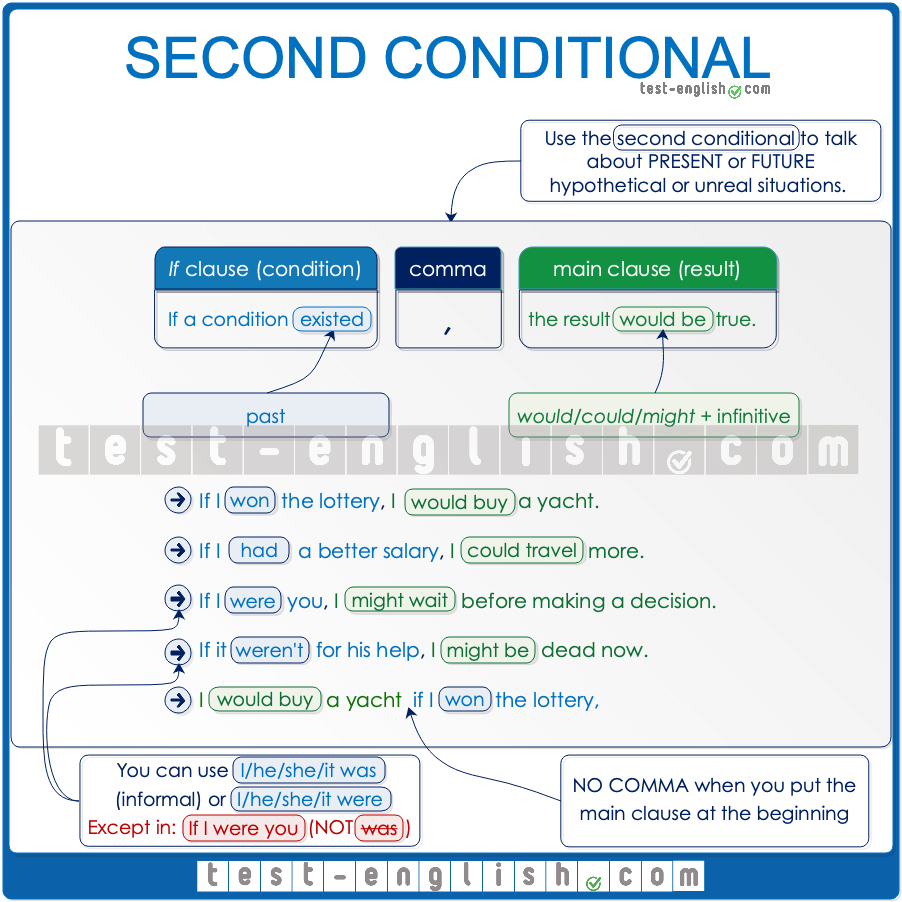
Download full-size image from Pinterest
If clause and main clause
We use if + past to talk about an imaginary present or future situation (although the verb is in the past, the meaning is present or future). And we use would + infinitive to talk about the result or consequence of that imaginary situation.
- If we had a mansion in the country, we’d go there every weekend.
- Would you travel around the world if you won the lottery?
Comma
When the if clause comes first, we usually put a comma after it. We don’t use a comma when the main clause comes first and the if clause comes second.
- If I won the lottery, I’d buy a mansion.
- I’d buy a mansion if I won the lottery.
Would
Would/wouldn’t is the same for all persons.
- I/you/he/she/it/we/they would/wouldn’t do that if it was possible.
Contracted forms are wouldn’t= would not and ‘d= would
- I‘d never tell anyone if you told me your secret.
- I wouldn’t tell anyone if you told me your secret.
Could
We can often use could + infinitive instead of would + infinitive in the main clause.
- If you spoke English, you could get a better job.
Was or were?
In the second conditional, we can use if I/he/she/it were (more formal) instead of if I/he/she/it was (spoken English).
- If I were/was fit, I would run a marathon.
- We wouldn’t have any problems if he were/was more reasonable.
But we use were (NOT was) when we give advice with the expression if I were you.
- If I were you, I would stay home and rest.
- I wouldn’t pay any attention to what he says if I were you.
First conditional vs Second conditional
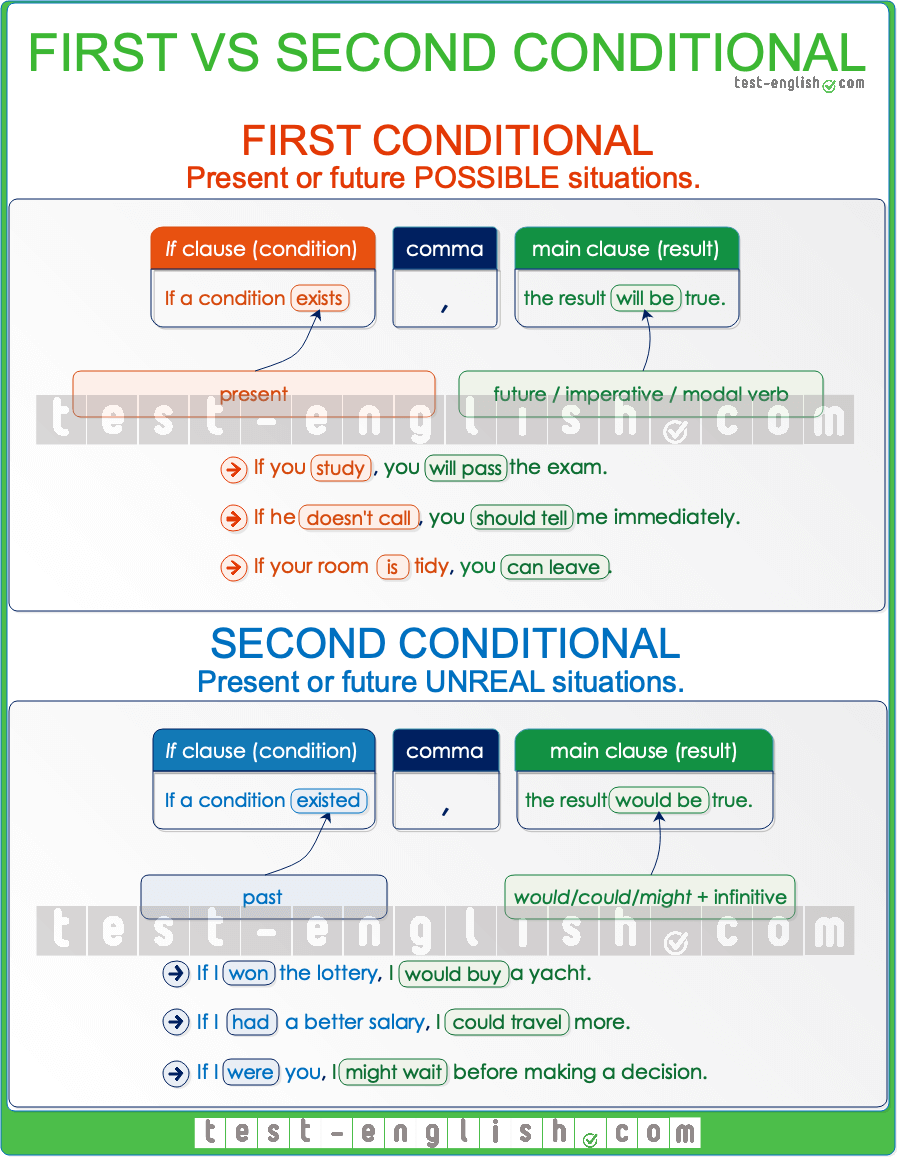
Download full-size image from Pinterest
We use the first conditional to talk about possible future situations and the second conditional to talk about hypothetical or imaginary future situations.
- If I don’t have a meeting tomorrow morning, I’ll have lunch with you. (It’s possible. Maybe I don’t have a meeting.)
- If I didn’t have a meeting tomorrow morning, I’d have lunch with you. (It’s hypothetical. I have a meeting tomorrow, so I won’t be able to have lunch with you.)
Ready to practice?
Put your knowledge to the test with interactive exercises (3 exercises available).
Download Lesson & Exercises as PDF
Get printable PDF worksheets for Second conditional including grammar explanations, exercises, and answer keys.