Future continuous and future perfect
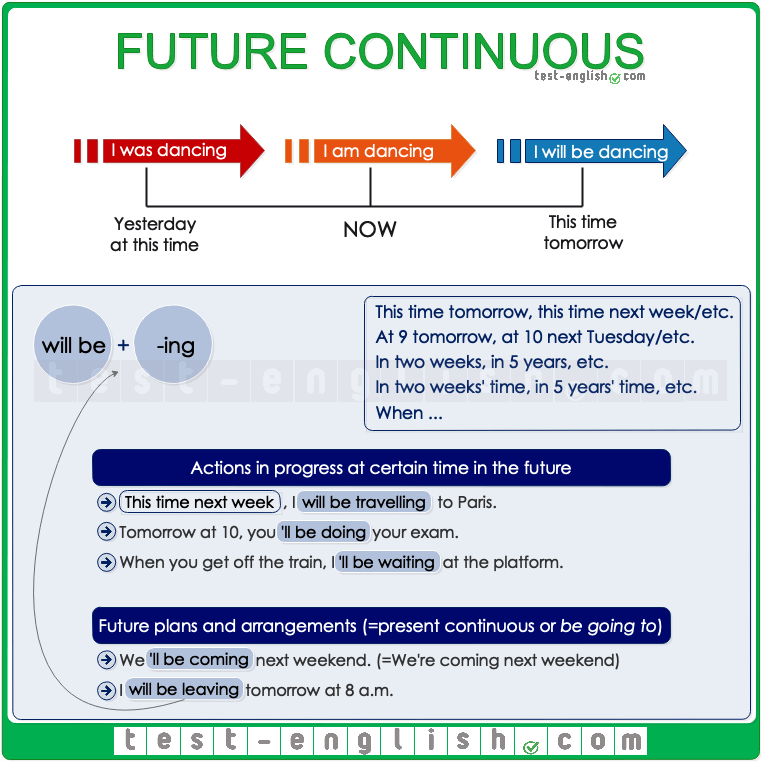
Future continuous: Grammar chart
Download full-size image from Pinterest
Future continuous: Use
Actions in progress in the future
We use the future continuous to talk about situations or actions that will be in progress at a certain time in the future.
- This time next week, we‘ll be travelling to Paris.
- Tomorrow at 10, you‘ll be doing your exam.
- When you get off the train, I‘ll be waiting on the platform.
- In two months’ time, we‘ll be lying on the beach and drinking a mojito.
Future arrangements (=present continuous)
We use the future continuous instead of the present continuous to talk about future events that have already been planned or decided.
- We’ll be coming next weekend.
- We’ll be leaving at 8 a.m. tomorrow.
Future continuous: Signal words
As you can see in the examples above, we often use the future continuous with time expressions such as:
- This time … (this time tomorrow, this time next week, etc.)
- When …
- At + time … (at seven tomorrow, at midday next Monday, etc.)
- In … (in two weeks, in three months, in five years, etc.)
- In …’ time (in two weeks’ time, in three months’ time, in five years’ time, etc.)
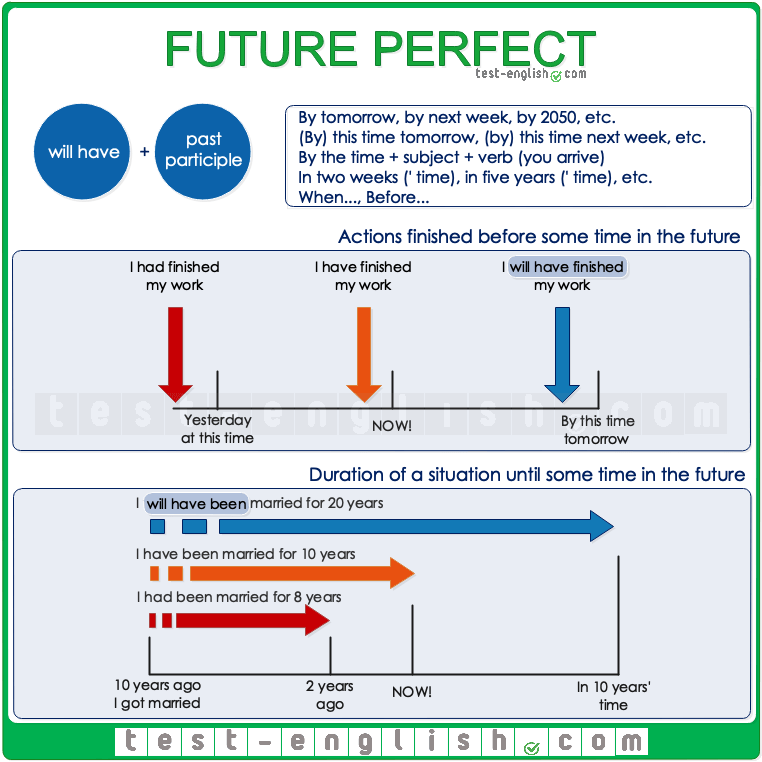
Future perfect: Grammar chart
Download full-size image from Pinterest
Future perfect – Use
Actions finished in the future
We use the future perfect for actions that will be finished before a certain time in the future.
- By 2050, researchers will have found a cure for cancer.
- By this time next year, I’ll have graduated.
- When you arrive tomorrow, we’ll have left.
Duration until some time in the future
We use the future perfect to talk about the duration of a situation until a certain time in the future.
- By the time I leave, I will have been in England for six months.
- In two years, we will have been married for twenty years.
Future perfect: signal words
As you can see in the examples above, we often use the future perfect with time expressions such as:
- By … (by tomorrow, by next week, by the end of the year, etc.)
- By this time … (by this time tomorrow, by this time next week, etc.)
- In … (in two weeks, in five years, etc.)
- When/Before …
By + time expression means ‘not later than’, ‘at’ or ‘before’ certain time.
Ready to practice?
Put your knowledge to the test with interactive exercises (3 exercises available).
Download Lesson & Exercises as PDF
Get printable PDF worksheets for Future continuous and future perfect including grammar explanations, exercises, and answer keys.