Ellipsis and substitution: Omitting or replacing words
Ellipsis
Download full-size image from Pinterest
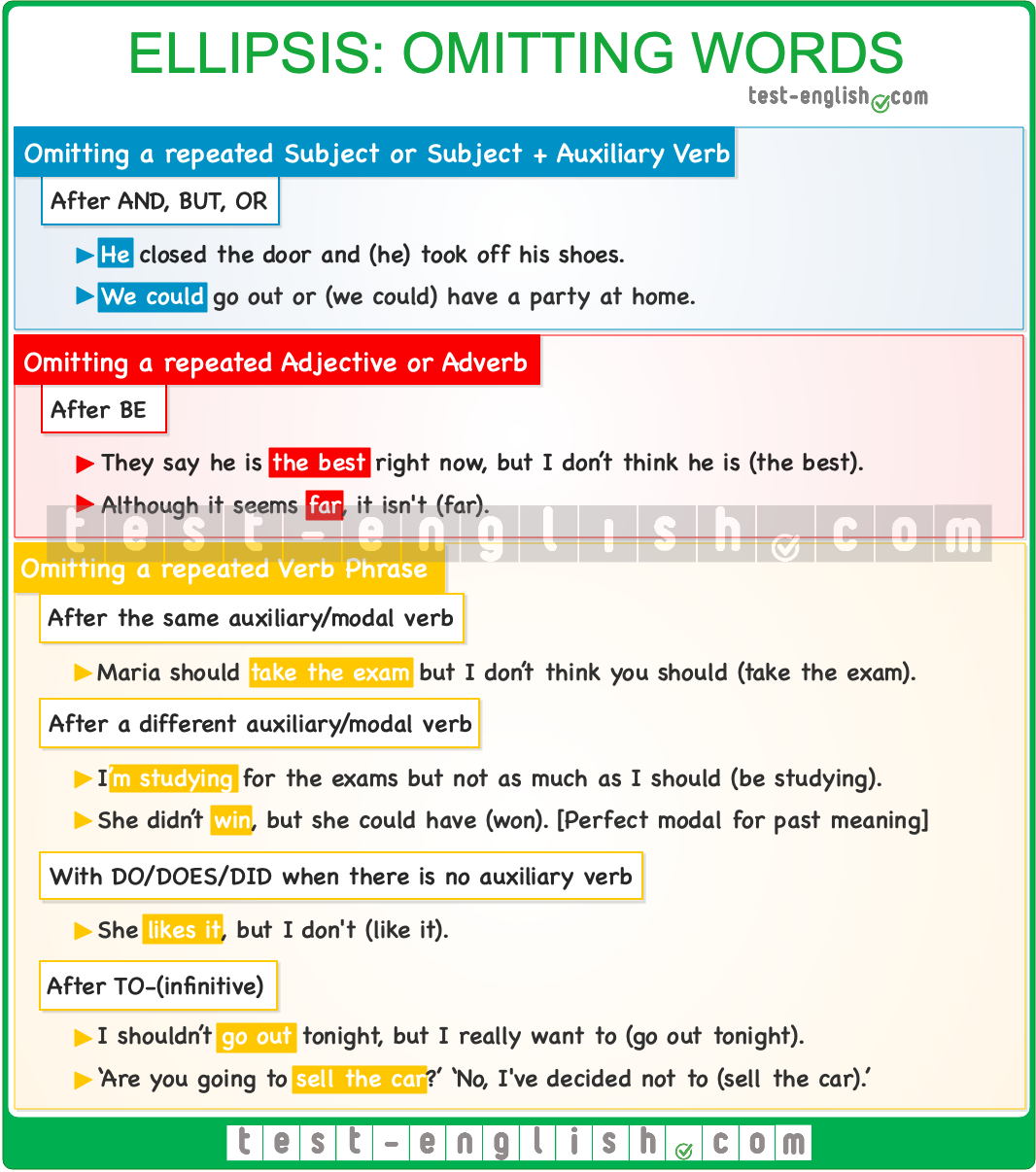
Repeated subject or subject + auxiliary verb
After and, but, and or, we can leave out a repeated subject or a subject + auxiliary verb.
- He closed the door and (he) took off his shoes.
- We could go out or (we could) have a party at home.
- She called, but (she) didn’t leave a message.
Repeated adjective or adverb after be
- They say he is the best right now, but I don’t think he is (the best).
- Although it seems far, it isn’t (far).
Repeated verb phrase
After the same auxiliary/modal
We can avoid repeating an adjective, a verb, or a verb phrase and repeat only the auxiliary or modal verb.
- Maria should take the exam, but I don’t think you should (take the exam).
- She’ll go to the meeting, but I won’t (go to the meeting).
After a different auxiliary/modal
We can also omit a repeated verb phrase when we use a different auxiliary or modal verb.
- I’m studying for the exams, but not as much as I should (be studying).
- I told you I’d help you, but I can’t (help you).
We may need to leave two auxiliaries to express past meaning in the second clause or sentence.
- She didn’t win, but she could have (won).
- ‘Did you go?’ ‘No, but I should have (gone).’
With do/does/did when there is no auxiliary verb
Use do/does/did in the second clause or sentence when the verb is present or past simple.
- She doesn’t like it, but I do.
- She liked it, but I didn’t.
After to-(infinitive)
This is called a reduced infinitive. It’s when you leave out a repeated infinitive or infinitive verb phrase after to.
- I shouldn’t go out tonight, but I really want to (go out).
- ‘Are you going to sell the car?’ ‘No, I‘ve decided not to (sell the car). ‘
Substitution
Download full-size image from Pinterest
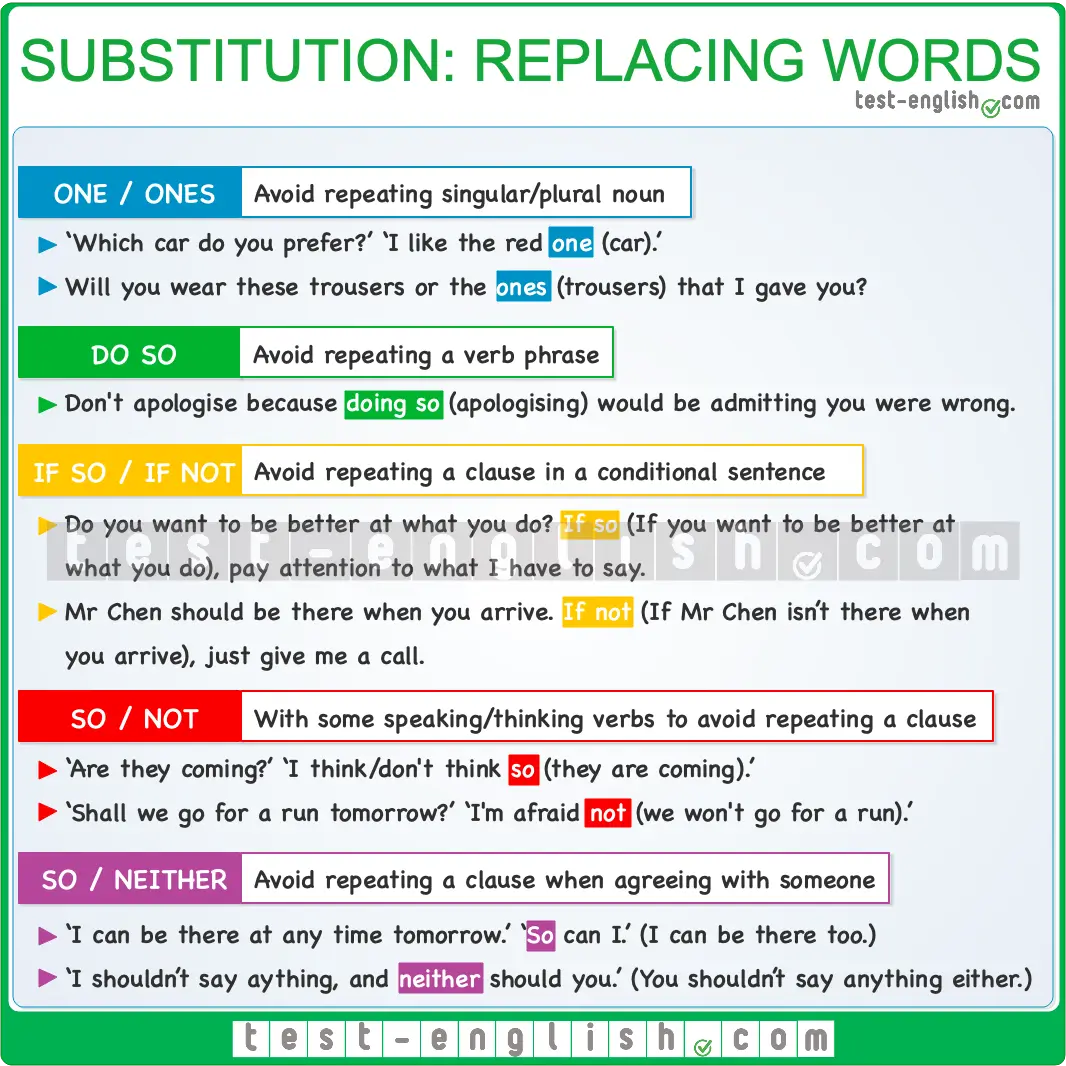
One, ones
We can use one to avoid repeating a singular countable noun, and we can use ones to avoid repeating a plural noun.
- ‘Do you need a pen?’ ‘No, I’ve already got one.’
- ‘Which car do you prefer?’ ‘I like the red one.’
- Will you wear these trousers or the ones that I gave you?
- I’d lend you a pen, but this is the only one I have.
Do so
We can use do so (or does so, did so, doing so, etc.) to avoid repeating a verb phrase.
- If I can help, I’ll be happy to do so. (=to help)
- I won’t apologise because doing so would be admitting that I was wrong. (=apologising)
We can also use do it/that (more informal) instead of do so.
- They told me to be quiet, and I did it/that/so.
If so, if not
We can use if so/if that is so (positive) or if not (negative) to avoid repeating a clause in a conditional sentence.
- Do you want to be better at what you do? If so, pay attention to what I have to say. (=If you want to be better at what you do)
- Mr Chen should be there when you arrive. If not, just give me a call. (=If Mr Chen isn’t there when you arrive)
Using so and not as substitutes for clauses
We use so after certain verbs of thinking and speaking to avoid repeating a positive clause. This use is common with the verbs assume, believe, expect, guess, hope, imagine, presume, suppose, suspect, say, tell sb, think and the expressions be afraid, and it seems/appears.
- ‘Are they coming?’ ‘I think so.’ (=they are coming)
- ‘I didn’t do it.’ ‘If you say so.’ (=that you didn’t do it)
- ‘Is she going to be there?’ ‘I hope so.’ (=she’s going to be there)
When we want to avoid repeating a negative clause, we can use a positive verb + not or a negative verb + so. We can use either of those forms with the verbs appear, seem, and suppose.
- ‘Did they leave a copy of the key?’ ‘It doesn’t seem so/It seems not.’
We usually use a positive verb + not with be afraid, assume, guess, hope, presume, and suspect.
- ‘Shall we go for a run tomorrow?’ ‘I’m afraid not. I have to be at the office all day.’
We normally use a negative verb + so with believe, expect, imagine, and think.
- ‘Will it take long to fix it?’ ‘I don’t think so.’
So, neither
We can use so and neither + auxiliary + subject to avoid repeating a clause when we are agreeing with someone.
- ‘I can be there at any time tomorrow.’ ‘So can I.’ (=I can be there at any time tomorrow too.)
- ‘I shouldn’t take the offer, and neither should you.’ (=and you shouldn’t take the offer either.)
If there is no auxiliary verb in the first clause or sentence, we use do/does or did.
- ‘I love this book.’ ‘So do I.’
- ‘We arrived on time, and so did all the other guests.’
Ready to practice?
Put your knowledge to the test with interactive exercises (4 exercises available).
Download Lesson & Exercises as PDF
Get printable PDF worksheets for Ellipsis and substitution: Omitting or replacing words including grammar explanations, exercises, and answer keys.