Comparative adjectives: Older than, more important than, etc.
Comparative adjectives
We use more + adjective + than or adjective + -er + than to compare things or people.
- My car is more expensive than your car.
- I am older than my brother.
In this chart, you can see when we need to use more … than or -er than and the changes in spelling.
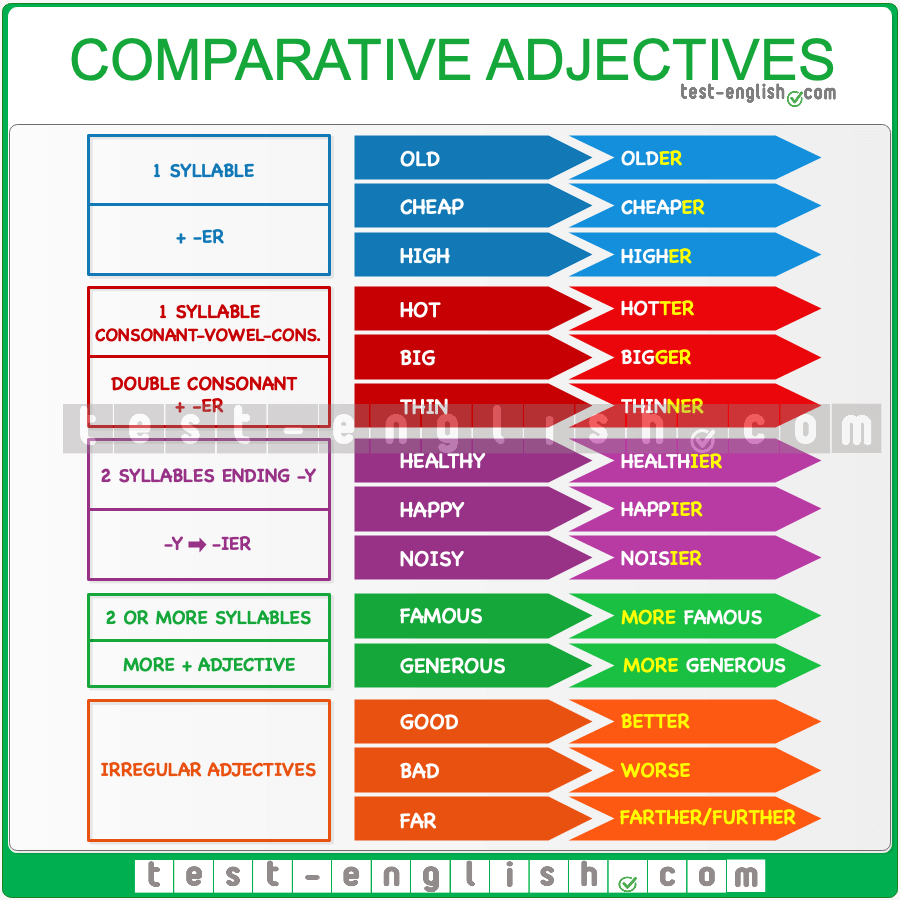
Download full-size image from Pinterest
Two things
We use the comparative form of an adjective to compare two things.
- Luke is taller than Mathew.
- This armchair is more comfortable than the sofa.
Less … than
When we compare two things, we can also use the form less + adjective + than (less ≠ more).
- Peter is less popular than Marta. (= Marta is more popular than Peter.)
Than me
If we use a personal pronoun after than, we need an object pronoun (me, you, him, etc.).
- My sister is taller than me.
- His sister is more intelligent than him.
Much/a bit + more
Before the comparative (more or –er), we can use much (=big difference) or a bit (=small difference).
- He’s a bit taller than me.
- Switzerland is much more expensive than Italy.
Common mistakes!
More or -er
We use more or –er, but we cannot use more + -er.
- My brother is more taller than me.

- My brother is taller than me.

More than (NOT that)
After a comparative adjective, we use than and NOT that.
- My brother is taller that me.
- My brother is taller than me.
Than + second element of the comparison
We use than + the second thing that we are comparing. When we don’t mention the second element of the comparison, we do NOT use than.
- I am tall, but my brother is taller than.
- I am tall, but my brother is taller.
Ready to practice?
Put your knowledge to the test with interactive exercises (3 exercises available).
Download Lesson & Exercises as PDF
Get printable PDF worksheets for Comparative adjectives: Older than, more important than, etc. including grammar explanations, exercises, and answer keys.